PHP 7.4.3 & 8.0.8
WordPress 6.5 · WooCommerce 9.1.0
Free-only stock, CSV, receiving and export checks. Selected minimum Free Firefox/WebKit workflows and actual PDF rendering were exercised.
StockControls Free · Handbook 1.1.23 · 4 November 2026
The task guides for StockControls Free, with installation, workspace navigation and recovery guidance.
Use the current matched Free and Pro packages. Update Free first, then Pro if installed, without uninstalling either plugin.
Current online documentation · Contact support · Download this handbook as PDF
Screenshots use fictional sample data. Earlier workflow examples are explicitly labelled 1.1.20; their retained images show that release’s interface. The instructions describe 1.1.23. New 1.1.23 workspace captures, where shown, are labelled separately.
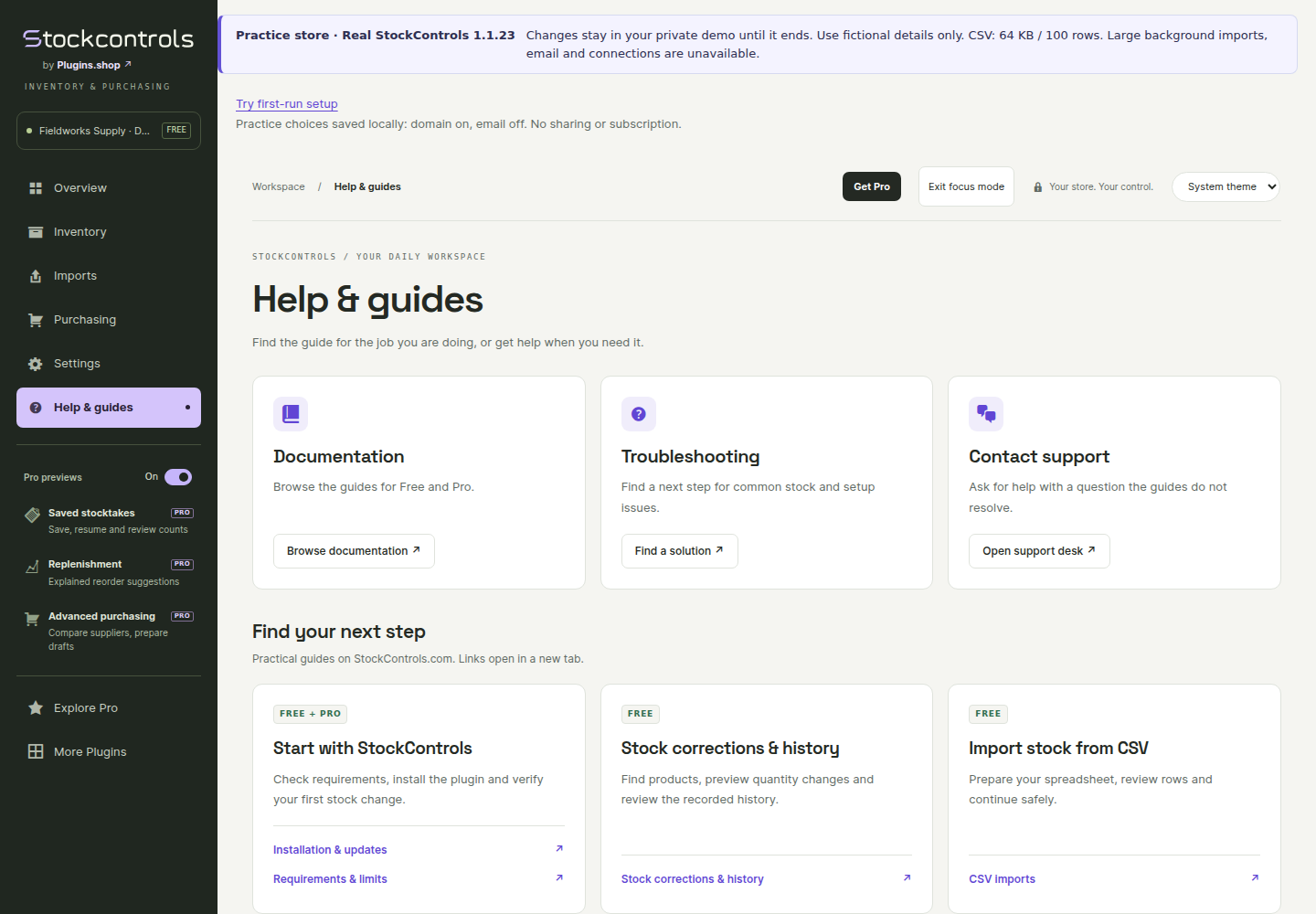
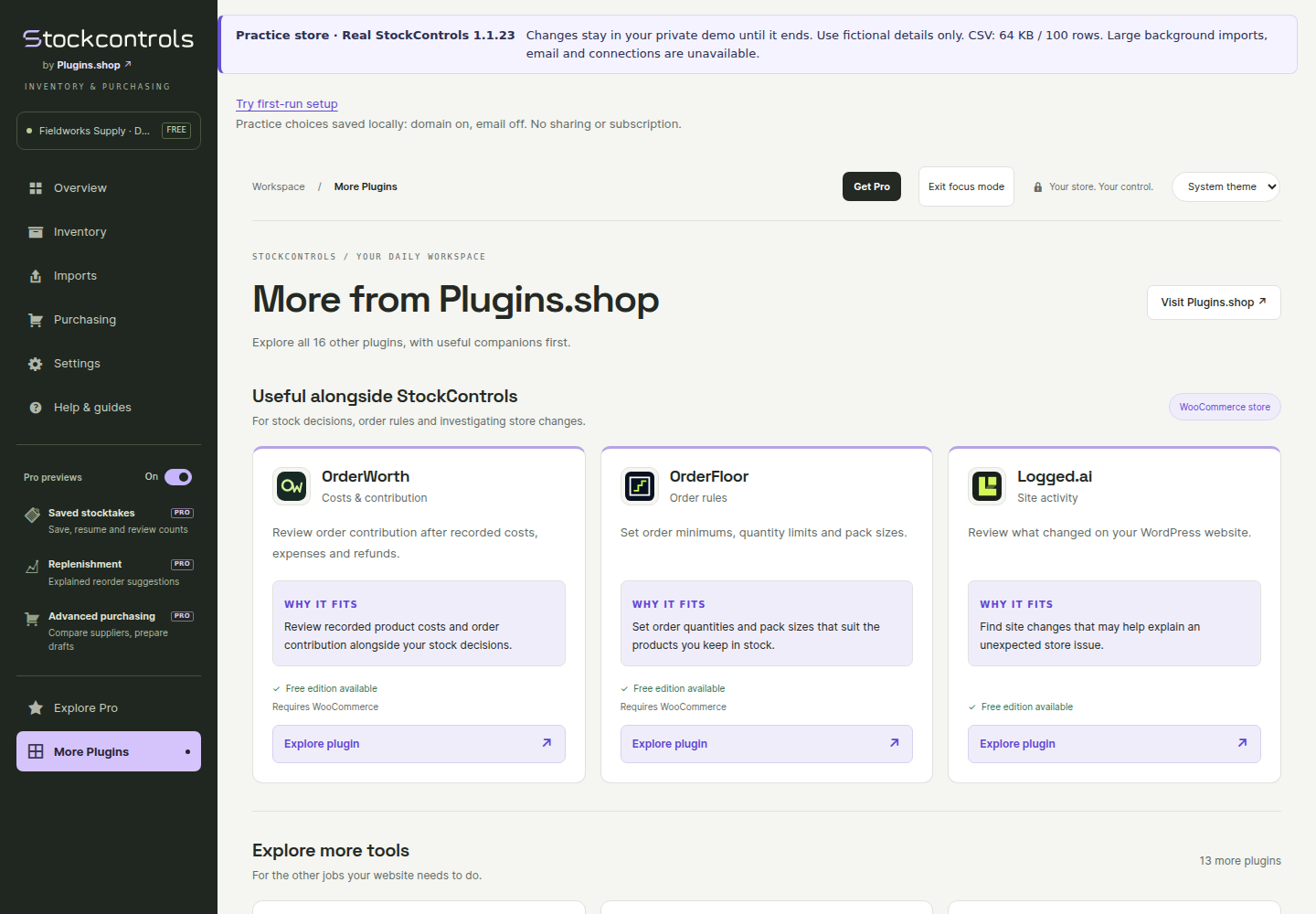
The short StockControls menu groups related tools. Choose a section, then use its tabs: Inventory → Products / Stock history, Imports → Import stock / Large CSV imports, and Purchasing → Purchase orders / Suppliers. Overview → Recent work helps you return to unfinished operations.
With Pro available, use Stocktakes → Saved counts / Team counts, Replenishment → Reorder suggestions (including Review slow-moving stock), or Purchasing → Buying basket. Open Settings for Preferences, Setup & health, History check, Welcome & privacy, Pro license and Pro updates, as permitted for your account. On a narrow screen, expand the workspace menu to choose a section.
Focus view gives StockControls its own sidebar and more room for the work. Use the focus control or Back to WordPress to return. On mobile, open the workspace menu to change sections.
Help & guides opens documentation, troubleshooting, support and both handbooks. More Plugins shows other tools from Plugins.shop.
In Free, the Pro previews On/Off switch shows or hides the three sample workflows. It remembers your choice for your WordPress account on this site. Help, Explore Pro and More Plugins stay available. Activated Pro uses its real workspace tools instead of the Free preview group.
Use a staging copy of your WooCommerce store and take a backup. Validate the installation against your own products and extensions. Check version and database requirements and test other stock, import, POS, or inventory extensions with it.
Have a simple stock-managed product and, if you sell variations, one variation with its own stock and one using parent stock ready for testing.
Prefer a printable reference? Download the Free handbook (PDF) or Pro handbook (PDF).
You can find the official StockControls listing on WordPress.org ↗ through Plugins → Add New Plugin. Check its available version before installing; if it differs from the matched pair below, use the current website ZIP for Free before adding Pro.
Keep Free installed and active. Download the matching Pro ZIP from your purchase account, upload it through the Plugins screen and activate it. The first eligible manual activation opens Settings → Pro license.
Copy your account's license key, review the hostname and choose Connect license. Public connection settings are bundled; no code edits are required. Activate a valid license once on this site to unlock Pro tools. After activation, those tools continue through expiry, service outages and later remote license changes. A successful local Disconnect or Reset local connection pauses Pro until a valid license is connected again. Saved records remain; Free workflows and authorized saved-stocktake exports stay available.
Disconnect first requests release of this site's remote seat. If that request fails, the local connection and earned Pro access remain: retry later, or explicitly choose Reset local connection to clear only this site's connection and Pro permission without sending a request. A local reset does not release the remote seat.
If activation is saved but background setup is reported incomplete, wait for the busy operation to finish and choose Refresh access to retry using the saved connection.
Free includes suppliers, purchase orders and partial/full manual receiving. Pro adds saved stocktakes, team counts, replenishment and supplier buying baskets. License setup never grants email-marketing consent.
Three clearly marked Pro previews explain saved stocktakes, replenishment and advanced buying. Their screenshots use fictional demonstration data. Viewing a preview changes no stock, sends no email and does not activate Pro.
Choose a demo to practice in a separate temporary store, or compare plans when the workflow is useful to you. Open Pro previews & suggestions in Setup & health or Explore Pro. Use the sidebar’s Pro previews On/Off switch or Hide preview pages / Show preview pages in those settings, or Hide suggestion / Show suggestion for Overview, low-stock inventory, counting and purchase orders.
Choosing Get Pro for Saved stocktakes, Get Pro for Replenishment or Get Pro for Advanced purchasing saves that workflow locally for your WordPress account on this store, then opens pricing. The choice is valid for up to seven days. Use Clear chosen task or choose another workflow to change it. Simply opening a preview does not save one. The task is not sent to the pricing website and never approves a stock change. WordPress schedules removal after expiry; a delayed cron may postpone physical deletion, but an expired choice is ignored.
Install the matching Pro add-on, complete the required first license activation, then continue your chosen task. The plugin checks current permissions, settings and data again. Count reconciliation and purchasing still require their normal reviews and confirmations.
An optional review invitation appears only on StockControls Overview after your account has made successful stock changes on at least five distinct days and 30 days have passed since its first recorded change. Visits and previews do not count. Choose Review on WordPress, Remind me in 14 days or No thanks. Reviewing or choosing No thanks permanently hides the invitation for that account and site. Review links in Setup & health and the WordPress Plugins row are optional. All review links and invitations remain hidden until WordPress identifies a public listing for this plugin. No rating is required or rewarded.
Current matched pair: Free and Pro 1.1.23. Pro 1.1.23 requires Free 1.1.23. For existing copies in the current folders, use Upload/Replace to update Free first, then matching Pro, without uninstalling either plugin. The current pair includes the stock safeguards and shared interface assets used by Pro.
Moving from the old stockcontrols folder: deactivate Pro and the old Free plugin. Keep the old Free plugin installed but inactive. Install and activate the new stockcontrols-inventory-operations Free plugin, then replace and activate matching Pro. Do not delete or uninstall the old folder as part of this move. Review and re-enable optional reminders or availability observations if wanted, and refresh planning data.
For Free, use WordPress updates when its directory release is available, or replace the ZIP without uninstalling. With a connected, eligible Pro license, open StockControls → Settings → Pro updates and choose Check for updates. A verified compatible release appears in WordPress Updates.
Optional scheduled checks discover updates about twice daily; enable them only if wanted. To install automatically, also choose Enable auto-updates for StockControls Pro on the WordPress Plugins page. These are separate choices, and the plugin enables neither by default. WordPress scheduling and the host can delay background work. Turn off scheduled checks in Pro updates to stop background discovery and delivery, or disable WordPress auto-updates to keep installation manual.
After renewing expired access, refresh the license or run a manual check. After successful first-site activation, Pro tools continue offline and after access expires. Back up and test updates on staging.
When updating from a version older than 1.1.20, rebuild any existing saved replenishment plans. Earlier calculated generations cannot be used with the current stock-reading rules. Your source products, orders, counts and purchasing records remain. Refresh the catalog map and sales if requested, then build a new plan; check current facts again before buying. An upgrade from before 1.1.17 may also need the stock-history index added in that release. Let storage setup finish and check Settings → Setup & health before changing stock.
Ordinary deactivation retains records. Free has an opt-in deletion setting for movement history and temporary batch results. Pending purchase receipts prevent deletion so they can recover safely; it does not delete WooCommerce quantities or thresholds. Supplier and purchasing records are retained after uninstall. Export and back up records before deliberate removal.
Search by product name, SKU, or ID. Click All products, Tracked stock, Running low or Zero or negative, then filter by category and sort. Reset clears the filters. Counts represent product listings; variations sharing a parent can refer to the same stock pool.
Save / manage views keeps the current search, filters and sorting under a name. Save up to 10 views per WordPress account and store. Views are private to your account and never store or change stock quantities.
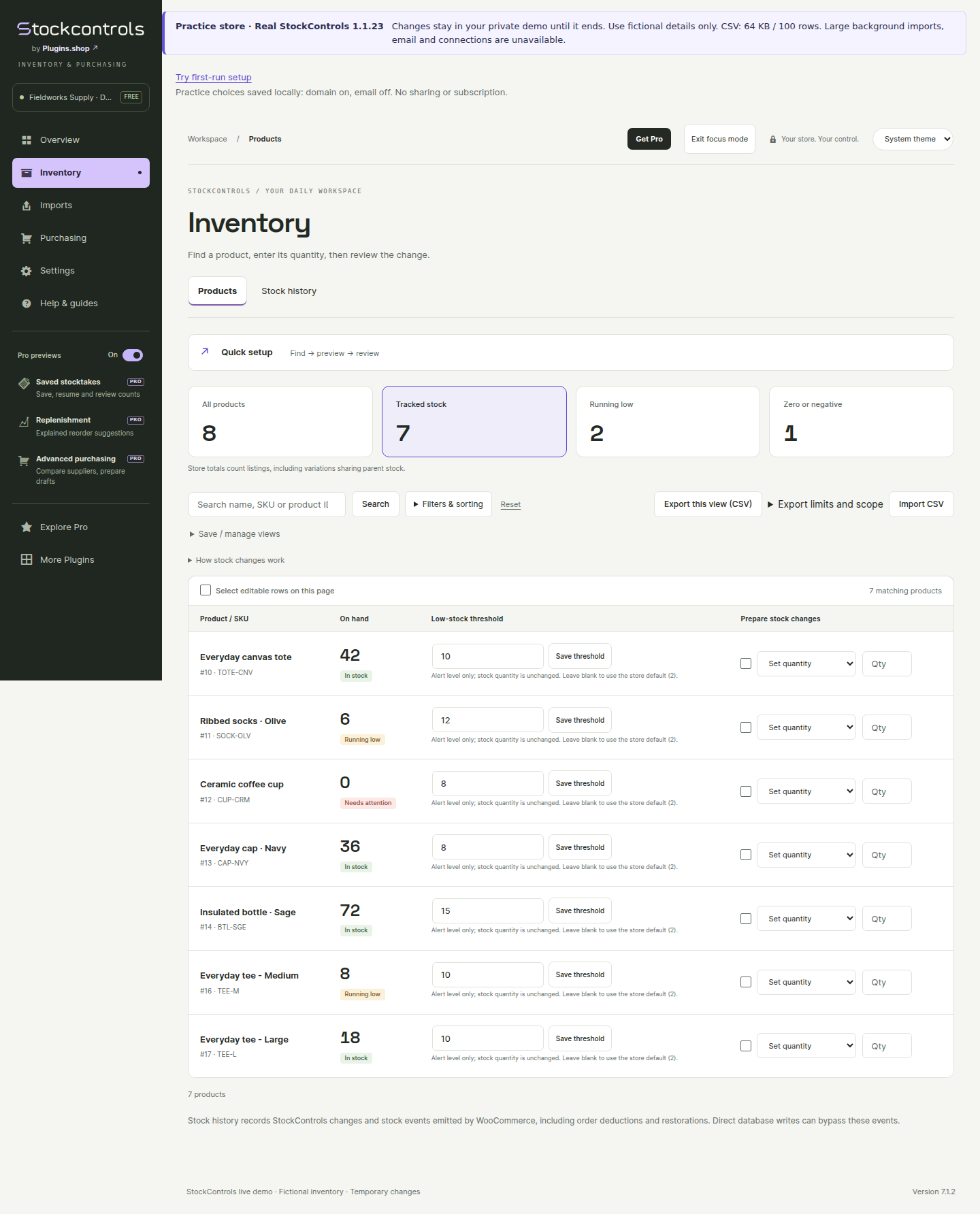
Batches contain up to 200 rows and apply at most 25 rows per click. A batch can partly succeed: it is not one all-or-nothing transaction. A preview can be discarded before applying; there is no saved-history undo.
Standard whole-unit WooCommerce setups reject unsupported decimal quantities. Configured fractional stock is accepted only when the store preserves its precision.
Open StockControls → Imports → Import stock and download the template. The upload form keeps detailed column rules in an expandable reference. Match by product_id or sku; if both are supplied, both must identify the same product. Use quantity for an exact count or delta for a quantity change, plus a reason. Optional expected_quantity checks the stock you expected when preparing the file.
This mapped-import path accepts up to 1 MB and 200 data rows. The separate Large CSV imports screen supports resumable imports up to 10 MB and 10,000 rows using exact template headers. Compare the two import paths. Duplicate products or multiple rows targeting the same shared stock owner are rejected. Invalid rows must be corrected before a preview can be applied. Review row results after applying; retry only rows identified as retryable.
Unapplied previews expire after 24 hours. Daily cleanup can remove never-started previews after 30 days without an update unless a saved stocktake still references them. Started batches, including completed ones, retain their recovery records while the plugin is active. Movement history has no automatic purge.
A variation managing its own quantity changes its own stock. An inherited-stock variation changes its parent’s pool. History identifies the requested product and the stock owner. Include a shared pool only once per batch.
Search current product names, SKUs or IDs, then filter by source and UTC date range. Rows show current names/SKUs alongside the unchanged recorded stock-owner and requested-product IDs. Names reflect the current catalog, not a historical snapshot.
Searches support up to 500 matching catalog products; refine a broader search. To find a removed product, clear the name/SKU search and use the separate exact Product ID field. CSV exports keep the same filters.
Records include before/after quantities, source, user or system, time, and a linked WooCommerce order where available. StockControls changes include your required reason.
While active, the plugin observes WooCommerce stock hooks for sales, restorations, restocked refunds, product edits, and compatible REST/import operations. Direct SQL writes bypass those hooks. Old movements are not backfilled, and third-party integrations need qualification.
An external logging failure or unverifiable simultaneous stock update does not block checkout; an admin notice identifies a possible gap. Uncertain nested or concurrent updates can leave incomplete history; unsupported external changes may still be missed without a notice. Turning stock tracking off or on can also require history review because the baseline changes between a quantity and no tracked quantity. StockControls writes keep their transactional movement record. This is an operational history, not a tamper-proof ledger.
Setup & health explains detected history warnings. Acknowledging one changes its reminder for your account; it does not reconstruct missing movements. New warnings still need review.
Save threshold changes the low-stock alert level only; it does not change the stock quantity. Enter a non-negative threshold on the stock-owning product, or explicitly clear it and save to use the WooCommerce default. Check the Saved feedback before continuing. To change stock, use the separate quantity field, reason and Preview selected changes, then review and apply the batch. If a threshold request cannot be confirmed, follow its reload guidance before saving that stock owner again. An interrupted response does not prove nothing was saved; check the stored value after reload. Keep any unfinished quantity/reason draft before leaving the page. Export filtered inventory or movement history as CSV. StockControls does not add a separate stock-alert email service.
Current guide · Free + Pro 1.1.23
Both import paths are included in Free. The smaller mapped importer accepts up to 200 rows / 1 MB and lets you map or ignore columns. The separate Imports → Large CSV imports screen accepts up to 10,000 rows / 10 MB, uses exact template headers and continues as resumable work.
Open Imports → Import stock for the mapped path. Download the template from the path you intend to use. The stock-import template is separate from an inventory export.
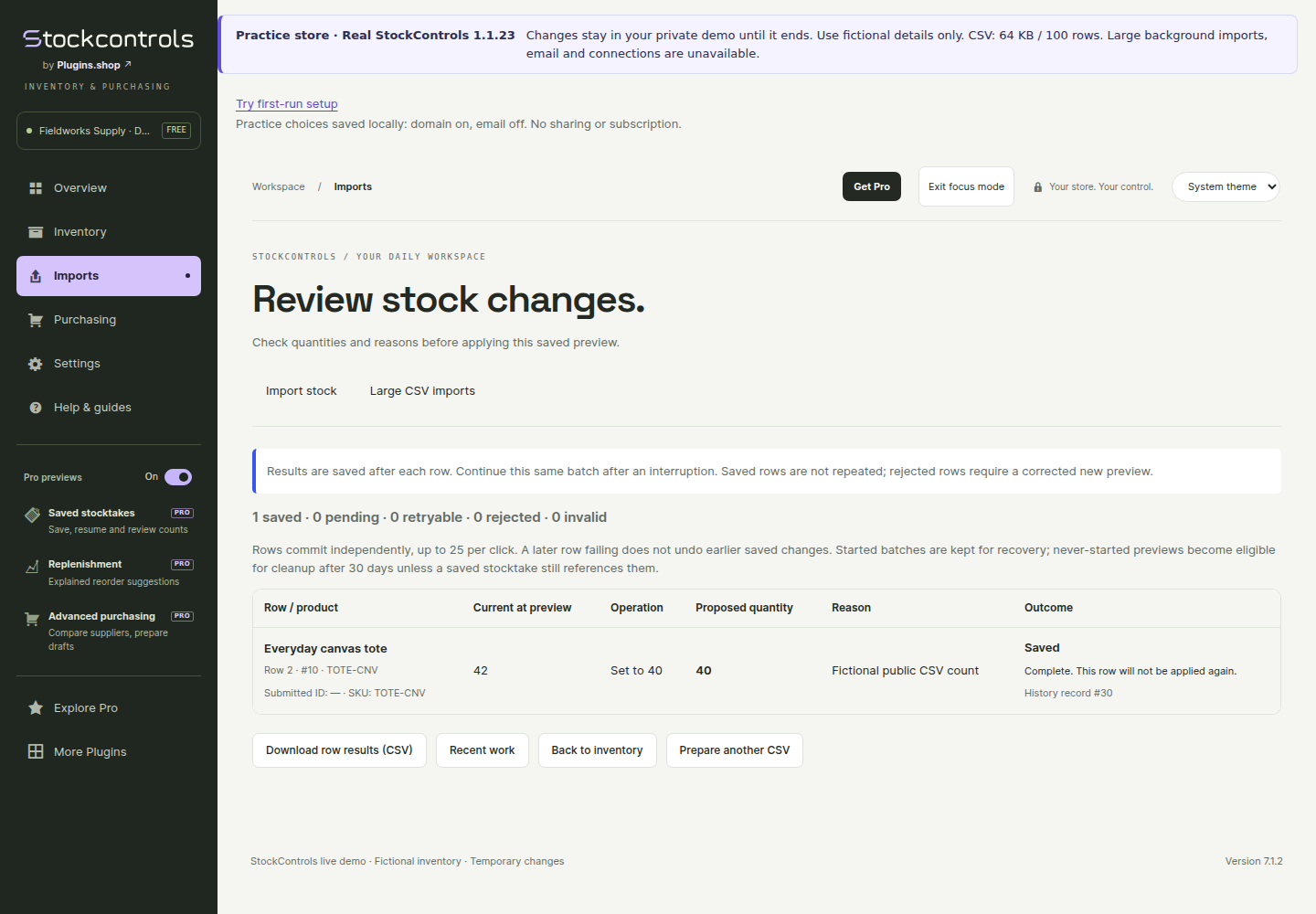
Use UTF-8, comma-separated values. Supply product_id or sku; if both are present they must identify the same product. Supply exactly one of quantity for an exact count or delta for a signed change. A row reason or default form reason is required.
Use a dot for decimals. Zero is valid for an exact quantity. Optional expected_quantity checks the stock you expected when preparing the file. The large importer accepts the exact headers product_id, sku, quantity, delta, reason, expected_quantity; other headers are rejected.
Quote fields containing commas or line breaks, and double any quote inside a quoted field. Malformed quoting is rejected before review; fix the CSV in your spreadsheet or text editor and upload it again. A rejected upload does not apply stock changes.
A shared stock pool must appear only once. Duplicate products or rows targeting the same stock owner are rejected. Your WooCommerce configuration must preserve any requested fractional precision.
Upload the file, inspect validation and review the proposed changes. Correct invalid rows before applying. Previewing does not update stock.
Check identifiers, existing quantities, requested quantities and reasons—not only the number of rows. A product that changed after the preview may be rejected for a fresh review.
Mapped imports apply at most 25 rows per click. Rows commit independently: a batch can partly succeed. Large imports use their own resumable workflow and row results. Read the saved, pending, rejected and retryable outcomes before continuing.
Reopen the same operation after interruption. Do not assume that a timeout or page reload means nothing was saved. Retry only rows identified as retryable; correct rejected or stale rows in a new preview.
Unstarted mapped previews expire after 24 hours. Daily cleanup can remove eligible never-started previews after 30 days without an update, unless a saved stocktake references them. All started batches, including completed ones, retain their recovery records while the plugin is active.
Large-import source chunks and results remain after completion or cancellation. Use the separately reviewed finished-import removal action while the plugin is active when you want to remove eligible finished work. Keep an export and backup when required. Never delete active recovery records directly.
Add a supplier in StockControls → Purchasing → Suppliers, then assign stock-owning products. Open Purchasing → Purchase orders → Create purchase order. Search by product name or SKU, then add lines while editing the draft, up to 50 products from the same supplier. The order list filters by status, overdue delivery, the next seven days or missing delivery dates.
Set quantities, unit costs, shipping, a manually entered tax amount, expected delivery date, supplier reference, and note. Currency precision follows the order’s stored settings. Values are operational purchase records, not an accounting or tax calculation.
New order lines retain a snapshot of the product name, SKU and supplier reference. A name can contain up to 250 characters, a SKU up to 100, and a supplier reference up to 200. An overlong field is identified before the order is created; correct it in the catalog instead of shortening the identifier silently. Existing order lines keep their original identity when amended, even if the catalog changes afterward.
Download PDF or CSV, or use the print view. For names outside the PDF font’s character coverage, the plugin directs you to the Unicode print view for your browser’s Save as PDF. Send the order through your usual supplier channel.
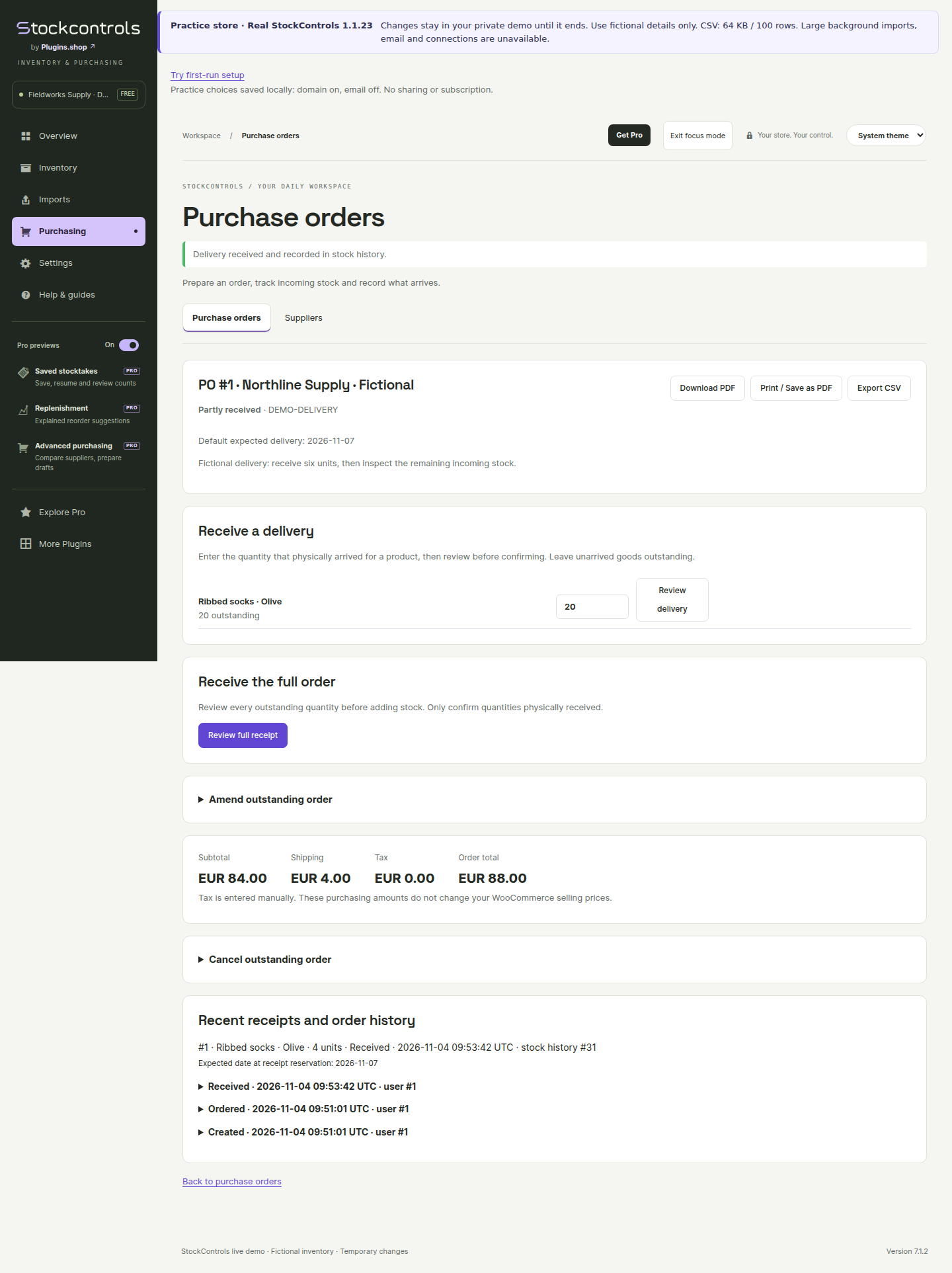
Mark an order ordered only after placing it with your supplier. Its outstanding units become incoming stock. Pro credits quantities due today through the product’s lead-time date and flags delivery risks separately. Free can edit or cancel drafts.
Free can amend quantities and details on an outstanding order, or cancel its remaining commitment, with a required reason. Received units are preserved and quantities cannot be reduced below those already received. A stale revision must be reloaded. Recover any pending receipt before changing the order.
Free: choose Review full receipt only when every remaining item has arrived. Check the listed quantities, then choose Confirm receipt and add stock.
Free: enter the actual quantity received on a line, choose Review delivery and confirm the partial receipt. Outstanding units stay visible until received or cancelled.
Reviewing alone changes no stock. Confirming increases WooCommerce stock and adds a linked StockControls movement. Repeating the same receipt token does not add stock twice. A new receipt is a separate physical delivery; verify it before saving.
Reload the same purchase order and retry its saved pending receipt. If the stock change already committed, recovery uses that recorded result. A full-order receipt may have completed some lines before an interruption; resume that operation rather than creating another.
Do not clear pending records directly in the database. Planning for an affected product and conflicting order changes pause until the pending receipt is resolved. Contact support if recovery cannot complete.
No supplier returns, automatic tax calculation, accounting integration, supplier email/API submission, or warehouse allocation. Supplier contacts, orders, events, and receipts stay in your WordPress database and survive ordinary uninstall.
Current guide · Free + Pro 1.1.23
Enable Manage stock on a sample WooCommerce product, clear the search and check the stock filter. Confirm whether the product owns its stock or inherits a parent’s quantity. Use Setup & health to inspect storage or catalog warnings.
Activate Free first, then Pro. Open StockControls → Settings → Pro license and connect a valid key to unlock Pro operations. If a previously activated site becomes locked, check whether its connection was reset, its URLs or WordPress salts changed, or local storage became unreadable. Existing records remain. A failed remote Disconnect keeps local access; Reset explicitly removes it. Use the current matching 1.1.23 pair and check Pro’s stricter WordPress 6.6 / PHP 8.1 requirements, WooCommerce 9.1+ and the current user’s permissions. The genuine dependency minimum is Free 1.1.23 / API2. Requirements and limits.
Save threshold updates only the low-stock alert level. To change quantity, enter it in the separate stock-change field, add a reason, choose Preview selected changes and apply the reviewed batch. If the threshold result is unconfirmed, keep your unfinished stock draft, follow the reload guidance and check the stored threshold before trying again.
Read the row’s message before retrying. Check the required reason, quantity precision, current stock owner, changed quantities and named-lock/InnoDB support. Reloading is not proof the change failed; inspect history and saved results first.
For stale stock, create a fresh preview. For interrupted work, resume the same batch or import. Do not submit a new correction merely because the response was interrupted.
Complete the sales refresh, check the snapshot date and window, inspect supplier assumptions and review delivery dates. Only outstanding goods due today through the lead-time date reduce suggestions.
Suggestions are zero when stock position is above the reorder point. Overdue, undated or later deliveries may still arrive; check them before buying again. A partial or failed refresh does not replace the last complete snapshot. Planning guide.
Reload the same purchase order and resume its saved pending receipt. Do not create a replacement receipt or clear the record directly. Recovery reuses already committed results instead of adding the same stock twice.
A full receipt can finish some lines before an interruption. Keep its saved operation and contact support if recovery cannot continue. Receipt recovery guide.
Open Setup & health and read the storage or history warning. Acknowledging it changes the reminder for your account; it does not reconstruct missing movements. Contact support if warnings recur. Changes between tracked and untracked stock, uncertain nested callbacks or external writes may leave history incomplete even when the stock save succeeds. Check the actual WooCommerce quantity and the affected operation before attempting another correction. StockControls observes supported WooCommerce hooks, not direct database edits.
Include your Free and Pro versions, WordPress / WooCommerce / PHP versions, classic or HPOS order storage, the exact error and steps to reproduce it. Explain the product’s stock settings and whether it also happens on staging.
Remove passwords, API keys, license credentials, payment details and unnecessary customer data from logs or screenshots. Open a private support ticket or use the email option there. Website tickets use a private link for replies. You can optionally request email updates from that ticket and confirm your address; after confirmation, receipts and future staff-reply alerts contain no private ticket key or conversation text. Keep the private link to read and reply. This is separate from newsletter signup. Email conversations receive replies by email.
When updating from before 1.1.20, rebuild saved replenishment plans. Earlier calculated generations use older stock-reading rules and are deliberately refused. Source products, orders, saved counts and purchasing records remain. Refresh the catalog map or sales if the screen requests it, then build a new plan.
On smaller screens, scroll the table to see all columns.
| Requirement | Free 1.1.23 | Pro 1.1.23 |
|---|---|---|
| WordPress | 6.5+ | 6.6+ |
| PHP | 7.4+ | 8.1+ |
| WooCommerce | 9.1+ | 9.1+ |
| StockControls Free | This package | Minimum 1.1.23 / API2; matching 1.1.23 required |
| Product storage | Standard WooCommerce product store | Same |
| Database | MySQL/MariaDB named locks and InnoDB tables | Same |
Install Free first, then the matching Pro add-on. Network-wide activation and custom product data stores are unsupported.
The mapped path accepts 200 rows / 1 MB, with up to 25 rows applied per click. The separate resumable Large CSV imports path supports 10,000 rows / 10 MB with exact template headers.
CSV guidePro live priority views cover up to 2,000 matching stock owners. Saved complete plans support up to 50,000 owners, subject to time, memory, storage and complete-coverage checks.
Planning guideOne supplier and up to 50 product lines per purchase order. The Pro stocktake selection screen starts a count with up to 25 products from the current page. Reconciliation and receipts use reviewed, bounded work with saved results.
Stocktake guideA sales refresh scans up to 50,000 orders in its chosen window. Shorter windows may be needed. A failed or capped run retains the previous complete snapshot.
Replenishment guideDecimals work only when your WooCommerce configuration preserves the requested precision, up to six decimal places. Standard whole-unit setups reject unsupported fractional inputs. Replenishment suggestions round up to whole units; alternative supplier terms can carry precise quantities when the store supports them.
Stock, audit and purchasing tables need InnoDB and MySQL/MariaDB named-lock support. Unsupported storage cannot accept StockControls stock changes. Your hosting provider can confirm these capabilities.
Warehouse quantity allocation, cross-store synchronization, camera scanning, barcode-label generation, supplier email/API ordering and accounting integrations are not included. A keyboard scanner can enter an exact SKU; saving scanned count progress requires Pro. Unknown stock is labelled unavailable instead of assumed to be zero. Correct its inventory record before relying on a suggestion.
The matched 1.1.23 runtime received selected native checks on the current and minimum environments below. Earlier 1.1.20 coverage remains separately labelled. Requirements are not a claim that every host, theme or extension combination has been tested.
Test your hosting and database configuration, other stock/POS/import extensions, product types, persistent-cache rules, theme, permissions and usual checkout flow. Network-wide activation and arbitrary custom product stores are unsupported. Two-site integration checks are not full multisite certification.
Keep a backup. Install Free first, then matching Pro without uninstalling, and verify a known stock workflow. Rebuild earlier saved replenishment plans after 1.1.20; source records, stocktakes and orders remain.
Current: WordPress 7.1.4, WooCommerce 11.2.1 and PHP 8.5.4. Minimum Free: WordPress 6.5, WooCommerce 9.1.0 and PHP 7.4.3. Minimum Pro: WordPress 6.6, WooCommerce 9.1.0 and PHP 8.1.34.
Selected Free and Pro workflow checks passed on both environments, with controlled fictional licensing responses. The new workspace, Help & guides, More Plugins and Free preview preference also have separate native browser checks. These checks do not establish real payment, inbox delivery or customer-host update delivery.
WordPress 6.5 · WooCommerce 9.1.0
Free-only stock, CSV, receiving and export checks. Selected minimum Free Firefox/WebKit workflows and actual PDF rendering were exercised.
WordPress 6.6 · WooCommerce 9.1.0
Native Pro workflows and authenticated graphical counting, planning, purchasing and CSV checks. This closes the earlier minimum-Pro browser gap. License service responses were fictional.
PHP 8.2.33, 8.3.6, 8.4.26 and 8.5.4 · WordPress 7.1.3 · WooCommerce 11.2.1
Selected stock/history, CSV, purchasing and Pro workflow checks. The late stock-reader correction has separate current/minimum proof.
Native checks used MariaDB 11.8.6 and MySQL 8.0.46. Actual legacy and HPOS WooCommerce order stores were verified separately, with order stock deductions, cancellation, quantity refunds and demand/history checks. A two-site integration used Redis Object Cache 3.0.0 with Predis. These are selected integrations, not coverage of every cache or network configuration.
Firefox 155 and WebKit 26.6 WPE covered current, minimum Free and minimum licensed-Pro workflows with desktop and phone-like viewports. Actual PDF responses were parsed and rendered, including PHP 7.4. Firefox download events passed; WPE was checked through authenticated PDF HTTP responses because its attachment download event was unavailable. These tests do not certify Safari, iPhone, physical devices or assistive technology.
The final 1.1.20 Free archive passed unmodified official Plugin Check 2.1.0 default, expanded and all five runtime checks with Pro physically absent: zero errors and warnings. Both readmes passed the official validator. Private Pro retains two errors and three warnings for its private updater and Update URI under WordPress.org directory rules; runtime checks pass. Pro is distributed privately.
Broader suites used earlier 1.1.20 candidates. The final raw-stock, numeric precision and layout corrections have separate native/browser regressions and fresh exact-archive package checks. PHP 8.2, 8.3 and 8.4 targeted raw-reader results precede the final scientific-notation branch. Earlier results are not relabelled as a complete rerun of every feature on the final archive.
A synthetic 5,000-product import exercised cancellation after 1,001 saves, uncertain-response recovery and a 3,999-row replacement. Final quantities and all 5,000 distinct movements were verified. The shared-host run took about five minutes and observed about 128 MiB peak memory; it is not a guarantee for 128 MB hosting or production checkout load.
Saved plans were checked with 10,000 and 50,000 synthetic products, expected quantities, ordering and totals and selected-supplier rows. A second 50,000-product run covered the corrected raw reader and corrected saved-plan calculations; it used integer stock and predates the final scientific-notation and CSS additions. Its warm shared-host sample used PHP 512M, with default browse samples around 2.4–3.8 seconds. This is not a full-final-package capacity or sustained-load claim.
WordPress automatic update tests on minimum and current Pro stacks preserved selected stock, history, settings, counts, purchasing and local license state. Provider metadata, tickets, signatures and entitlement were controlled fictional fixtures and earlier source generations. They do not prove current paid-provider delivery through a customer host’s ordinary network.
Historical browser-update and TEST-mode payment checks retain their earlier version labels. Genuine paid purchase, renewal, refund, inbox delivery, customer automatic updates and installation of WordPress.org’s actual generated Free ZIP need separate acceptance checks.
The demo shows the real workflow with fictional data. A staging copy checks the fit with your products and extensions.