Compare when available stock runs out under a stated usage assumption with when each delivery becomes usable. In this hypothetical example, 12 opening units, usage of three per day and 18 units usable at the start of day 7 leave six units uncovered on days 5–6: a timing gap, not an automatic six-unit order.
If opening stock plus verified outstanding units is below the planning window’s assumed usage, there is a quantity shortfall. Unknown usable dates leave timing unresolved.
Build a coverage sheet for one stock-keeping unit (SKU). This is a planning scenario—not a stock adjustment, actual backorder record, demand forecast or purchasing instruction.
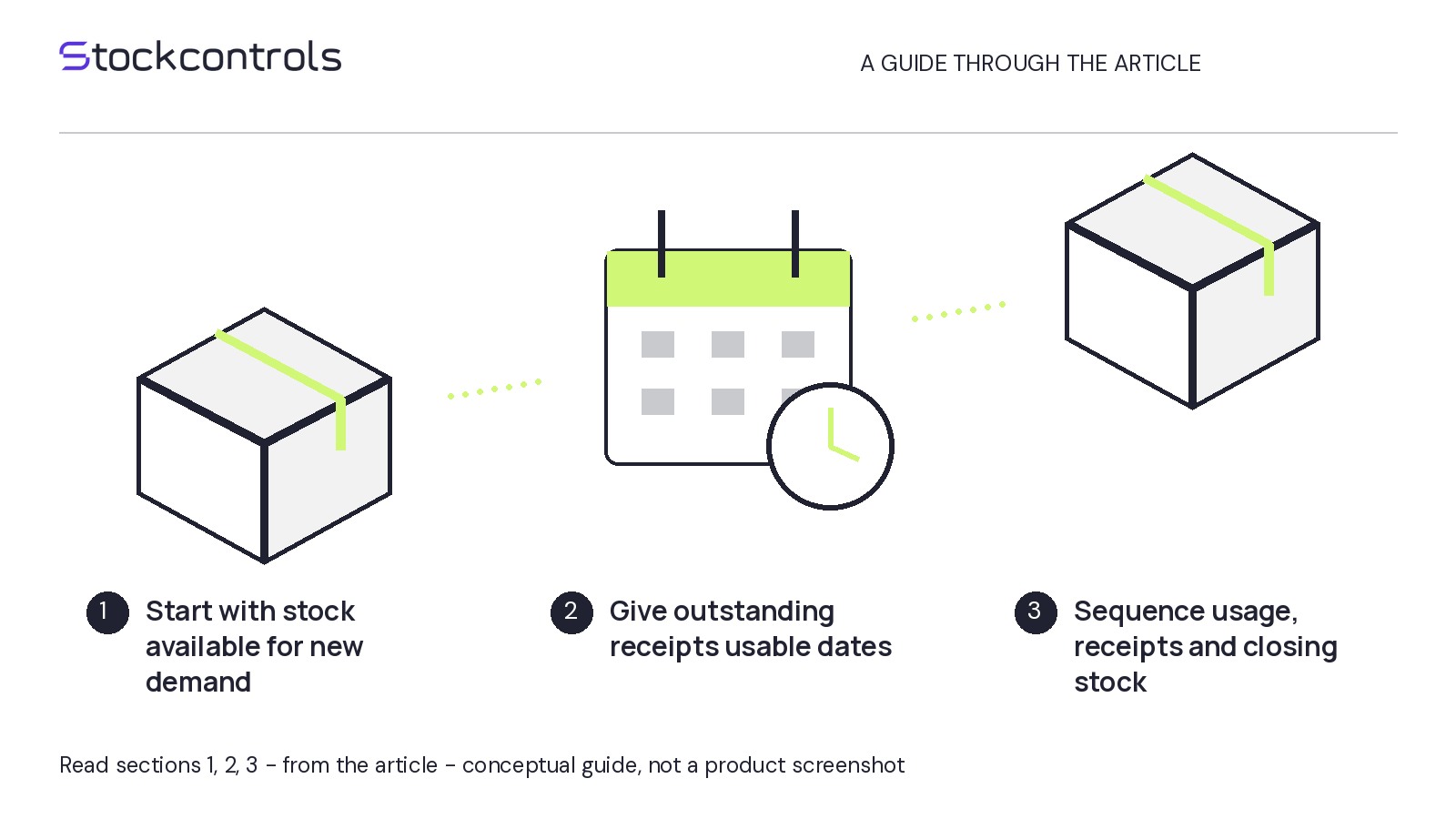
Start with stock available for new demand
Record the SKU or variation, stock pool, cutoff time and time zone, planning end date and units of measure.
Use a reconciled opening balance of usable stock available for new demand. If existing customer commitments are already excluded from that balance, do not subtract them again; otherwise account for them once.
Exclude expected deliveries and damaged or quarantined units. Record the opening balance and supporting evidence, and resolve unexplained differences before planning purchases.
Give outstanding receipts usable dates
For each open supplier order, record:
- Order reference and exact item.
- Units still due after receipts and confirmed amendments or cancellations.
- Dated supplier correspondence supporting dispatch or arrival information.
- Receiving or inspection time before the units become usable.
- The resulting usable date, labelled confirmed, estimated or unknown.
Dispatch is not arrival, and arrival is not necessarily availability. State whether receipts become usable before or after that day’s assumed usage.
A supplier-confirmed date is evidence, not a guarantee. If you cannot establish a usable date, keep timing unresolved; do not place those units at the start of the timeline.
Sequence usage, receipts and closing stock
Declare a usage assumption for new demand, its basis and applicable days. Keep it fixed while testing delivery timing. The three-unit daily rate below is illustrative, not a recommendation.
Daily columns: Date; opening stock; usable receipts; assumed usage; covered usage; uncovered usage; closing stock.
Work in time order within each day. Carry forward unused stock, add receipts only when usable and subtract covered usage to find closing stock. Record uncovered usage separately; later receipts cannot cover it on time.
Uncovered assumed usage is not fulfilled later in this example. It is a planning gap, not a customer commitment. Account for actual commitments once before relying on the closing balances.
For the hypothetical baseline, a supplier email dated 1 June gives arrival on 6 June. Allowing for planned receiving, record the 18 outstanding units as estimated usable at the start of 7 June.
TRY THE SCENARIOS
How do delivery choices change the gap and closing stock?
Hypothetical, 1–10 June 2027, UTC: start with 12 units; assume usage of three per calendar day. All receipts are usable at the start of the stated day. Unmet usage is not carried forward. No other commitments or movements apply; a six-unit bridge is assumed obtainable.
All 18 units usable on 7 June
The opening 12 cover 1–4 June. Days 5–6 leave six units uncovered. The receipt covers 12 units of usage on 7–10 June. Closing stock on 10 June: six units.
All 18 units delayed to 9 June
Days 5–8 leave 12 units uncovered. The receipt covers six units of usage on 9–10 June. Closing stock on 10 June: 12 units. This tests a delay; it does not predict one.
Six existing units on 5 June, 12 on 7 June
The split covers all 30 units of assumed usage on time. Closing stock on 10 June: zero. This changes receipt timing without adding units.
Six extra bridge units on 5 June, original 18 on 7 June
The bridge and original order provide 24 incoming units. Including the 12 opening units gives 36 units of total supply. All 30 units of assumed usage are covered on time. Closing stock on 10 June: six units.
Compare all scenarios
| Situation | What happens |
|---|---|
| All 18 units usable on 7 June | The opening 12 cover 1–4 June. Days 5–6 leave six units uncovered. The receipt covers 12 units of usage on 7–10 June. Closing stock on 10 June: six units. |
| All 18 units delayed to 9 June | Days 5–8 leave 12 units uncovered. The receipt covers six units of usage on 9–10 June. Closing stock on 10 June: 12 units. This tests a delay; it does not predict one. |
| Six existing units on 5 June, 12 on 7 June | The split covers all 30 units of assumed usage on time. Closing stock on 10 June: zero. This changes receipt timing without adding units. |
| Six extra bridge units on 5 June, original 18 on 7 June | The bridge and original order provide 24 incoming units. Including the 12 opening units gives 36 units of total supply. All 30 units of assumed usage are covered on time. Closing stock on 10 June: six units. |
Illustrative examples. Your selection is not saved or sent, and changes no store settings.
The baseline has 30 units of total supply against 30 units of assumed usage, but not on the right dates. Advancing existing supply closes the gap without adding units. Compared with that split-delivery option, the extra bridge leaves six units at the end of 10 June rather than zero.
Turn the gap into a supplier request
1. Request an earlier portion
Ask whether six of the existing 18 units can be usable at the start of 5 June and the remaining 12 at the start of 7 June. Confirm arrival timing and your receiving capacity, not just dispatch.
2. Replace receipt lines on confirmation
Replace the original 18-unit line in your sheet with the two agreed portions. Do not add six accelerated units while leaving all 18 on the original line. Retain the supplier’s reply as evidence.
3. Review a bridge if acceleration is unavailable
Check whether extra supply can become usable before the gap starts. Review the quantity you can obtain, pack sizes or minimums, known costs and unresolved charges. Six units is an example, not a purchase instruction.
A later bridge does not close the whole gap. The original order remains outstanding unless an amendment or cancellation is confirmed.
4. Update the sheet and assign a deadline
Update the timeline with all remaining receipts before approving extra supply. Record the first uncovered date, gap units and closing stock.
For a hypothetical request sent by buyer Jo on 1 June, the reply deadline might be 2 June at 12:00 UTC. Base your own deadline on supplier and receiving lead times so an alternative can become usable before the gap starts. If feasibility is unknown, record it.
Keep the SKU, gap dates and units, missing evidence, next action, owner and reply deadline with its time zone together on the coverage sheet.
Complete the sheet for one SKU, then send the supplier your timing request with the required quantities, dates and reply deadline.